Pages

Showing posts with label Politics. Show all posts

Monday, November 8, 2010

Political Musings of the Day

Share
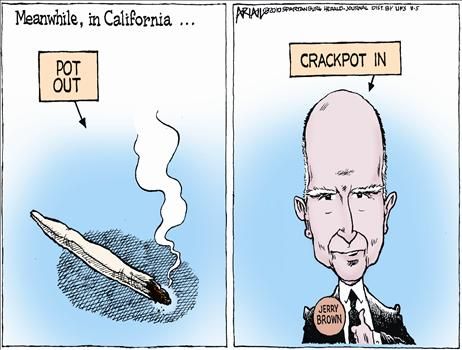
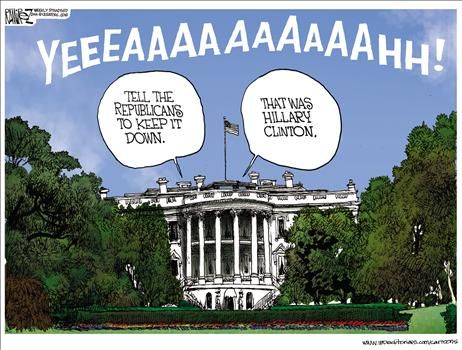
I took a hiatus due to work related demands but I'm back.  The midterm election results have been analyzed ad naseum.  The results were about what I expected, and frankly, we need a check on a larger and increasingly intrusive government, even if it means gridlock.  So here are some cartoons to enjoy for now (via Townhall and About.com):


Monday, August 30, 2010

The Conservative Revival

Share
Peter Berkowitz in the WSJ pens an eloquent articulation of conservatism, highlighting its strengths that progressives often ignore: 

Progressives like to believe that conservatism's task is exclusively negative—resisting the centralizing and expansionist tendency of democratic government. And that is a large part of the conservative mission. Progressives see nothing in this but hard-hearted indifference to inequality and misfortune, but that is a misreading.


What conservatism does is ask the question avoided by progressive promises: at what expense? In the aftermath of the global economic crisis of 2008, Western liberal democracies have been increasingly forced to come to grips with their propensity to live beyond their means.


It is always the task for conservatives to insist that money does not grow on trees, that government programs must be paid for, and that promising unaffordable benefits is reckless, unjust and a long-term threat to maintaining free institutions.


But conservatives also combat government expansion and centralization because it can undermine the virtues upon which a free society depends. Big government tends to crowd out self-government—producing sluggish, selfish and small-minded citizens, depriving individuals of opportunities to manage their private lives and discouraging them from cooperating with fellow citizens to govern their neighborhoods, towns, cities and states.


It really is a must read-all piece, for Berkowitz reminds conservatives they must accept the political realities of the New Deal, and demonstrate how they will dedicate government to "effectively discharge" duties of reigniting the economy, making health care more affordable, and getting people back to work. He points out to conservatives that free markets and liberty, for all their benefits, can also bring instability and erosion of respect for tradition. When conservatives recognize these disruptions can have profound impacts to people's lives, and convey to voters they want to preserve a safety net to help one navigate capitalism's potholes while preserving its best effects--innovation, a continual raise in standards of living, and most of all--opportunity for the American dream, voters will gravitate back to these principles. It's a timeless message that reminds us that economic freedom is inextricably entwined with individual freedom, and an attractive reflection of traditional American values that imparts that with freedom comes responsibility.


Wednesday, August 25, 2010

Ammo Check

Share
Yup, the EPA is considering a petition to ban all lead based ammunition.  According to the Washington Examiner:

NSSF [National Shooting Sports Foundation]  is springing into action, as the public comment period opens on EPA considering a regulation that will ban all traditional lead ammunition. This would basically end the shooting sports as we know it. Remember this is a no-win situation for us, because bullets made of materials other than lead are often considered armor piercing by law. Copper is your basic material, and copper is expensive, and has much poorer performance properties than lead.

Hotair discusses:

As NSSF has pointed out, there’s no real scientific basis for restricting lead ammunition. Just about all shooting ranges at this point are recycling their lead (it’s too valuable to just leave in the ground). California’s ban has not been shown to reduce lead levels in Condors, and has driven more people away from hunting. Additionally, it’s interfered with lawful self-protection in parts of California that are considered condor habitat.


The date the comments period ends on the EPA website is two days before the midterms. And you thought the culture wars have simmered down in favor of fiscal sanity, didn't ya?

Update: EPA decides not to hear the petition, stating it doesn't have the jurisdiction to weigh in on controversial Second Amendment issues.

Wednesday, August 18, 2010

Who's Up for Some Ground Zero Mosque Ads?

Share
You knew it was inevitable.  The first is from Liz Cheney's group, Keep America Safe (updates via Hotair).


The second one is from the National Republican Senatorial Committee. It's part of a larger theme in trying to convince voters that Democrats are the extremists. One of the examples included is the One's words of support to the mosque.


Now even Howard Dean is taking a page from Harry Reid, who's in the election fight of his life against Sharron Angle. Dean says the mosque should be moved.


Tuesday, August 17, 2010

Pelosi: Investigate Opposition to Ground Zero Mosque

Share
First the President steps in the fracas, creating an enormous backlash. As Powerline points out, the tone of his remarks supporting the mosque was not designed to persuade. It was another lecture from a law professor, and ends up belittling those who oppose the mosque. Now witness the perverse moral logic of the Left (h/t: RedState). Speaker of the House Nancy Pelosi on San Francisco radio:


"There is no question there is a concerted effort to make this a political issue by some. And I join those who have called for looking into how is this opposition to the mosque being funded," she said. "How is this being ginned up that here we are talking about Treasure Island, something we've been working on for decades, something of great interest to our community as we go forward to an election about the future of our country and two of the first three questions are about a zoning issue in New York City." (h/t Kristinn)

It's symptomatic of how completely out of step the Left is with the rest of America. And in breathtaking denial of what's coming in the November.

Update:
Pelosi and Obama need to take a page from the director of Al-Arabiya:

"The Muslims never asked for this [mosque], and even the angry Muslims do not want it. This is one of the few times when the two opposing sides are in agreement. Nevertheless, the dispute flared up. It made the front pages of newspapers and [featured on] the major television programs. Demonstrations were held in the streets, and large posters were plastered on New York buses, demanding that the construction of the mosque be prevented and reminding everyone of the 9/11 crime. This really is a strange battle!

"I can't imagine that Muslims [actually] want a mosque at this particular location, because it will become an arena for the promoters of hatred, and a monument to those who committed the crime. Moreover, there are no practicing Muslims in the area who need a place to worship, because it is a commercial district. Is there anyone who is [really] eager [to build] this mosque?...

"Those pushing to build this mosque may be construction companies, architect firms, or political groups who want to exploit this issue. The individual who submitted the building application – I do not know whether he [really] wants [to build] a mosque that will promote reconciliation, or whether he is [just] an investor looking for quick profits. Because the idea of a mosque right next to a site of destruction is not at all an intelligent one. The last thing Muslims want today is to build a religious center that provokes others, or a symbolic mosque that people will visit as a [kind of] museum next to a cemetery.

"What the citizens of the U.S. fail to understand is that the battle against the 9/11 terrorists is not their battle. It is a Muslim battle – one whose flames are still raging in more than 20 Muslim countries... I do not think that the majority of Muslims want to build a monument or a place of worship that tomorrow may become a source of pride for the terrorists and their Muslim followers, nor do they want a mosque that will become a shrine for the haters of Islam... This has already started to happen: [the Islamophobes] are claiming that a mosque is being built over the corpses of 3,000 U.S. citizens who were buried alive by people chanting 'Allah akbar' – the same call that will be heard from the mosque..."


Even Al-Arabiya gets it.

Classic: Reagan on Government

Share
A timely video from the Republican Study Committee (h/t: Powerline):

Monday, August 9, 2010

More Muslims Speak Out Against Ground Zero Mosque

Share
From the WaPo, Neda Bolourchi lost her mother on Sep 11 at Ground Zero. She was on United Flight 175 that the terrorists flew into the south tower of the WTC. She is a Muslim who left Iran during the revolution, and eloquently expresses that she has no grave site to visit, nor was she able to bury her mother in a proper funeral. On the Ground Zero mosque, she says:

On the day I left Ground Zero shortly after the tragedy, I felt that I was abandoning my mother. It was like being forced to leave the bedside of a loved one who is dying, knowing you will never see her again. But I felt the love and respect of all those around me there, and it reassured me that she was being left in good hands. Since I cannot visit New York as often as I would like, I at least want to know that my mother can rest in peace.

I do not like harboring resentment or anger, but I do not want the death of my mother -- my best friend, my hero, my strength, my love -- to become even more politicized than it already is. To the supporters of this new Islamic cultural center, I must ask: Build your ideological monument somewhere else, far from my mother's grave, and let her rest.


Raheel Raza, a board member of the Canadian Muslim Association, bluntly tells Bill O'Reilly why a mosque near Ground Zero does not heal Muslim relations with the west (H/T: Hotair):


These are the type of moderate Muslims we should be turning to--they understand the sensitivities regarding Ground Zero and acknowledge that terrorists attacked us in the name of Islam.

Friday, August 6, 2010

61% of NYers Oppose Mosque Near Ground Zero

Share
In light of NYC's Landmarks Preservation Commission's unanimous decision to allow a building to be torn down to clear the way for the building of a huge mosque 2 blocks from Ground Zero, Sienna Research conducted a survey of over 600 NYers.  For registered voters, here's the breakdown:


17. Supporters of the proposed community center, known as the Cordoba House, say it would demonstrate the presence of moderate Muslims in New York as well as serve as a monument to religious tolerance. Opponents say the project is an offense to the memory of those killed in the attacks on 9/11 and displays unacceptable insensitivity. Do you tend to agree with the supporters, the opponents or do you think they both have a legitimate position?

Agree with supporters:  21%
Agree with opponents: 37%
Both have a legitimate position: 38%
Don't know/refused: 4%

18. Do you support or oppose the proposal to build the Cordoba House, a 15 story Muslim Cultural Center in lower Manhattan 2 blocks from the site of the World Trade Center? 

Support: 27%
Oppose:  61%
Don't know/refused: 12%

Seems as if NYers understand the nuance of the arguments as the majority are able to see both sides of the issue. However, they still ultimately oppose the mosque by a large majority. If you review the breakdown, even self-described liberals oppose the building of the mosque by 52/36. Opposition cuts across all categories: gender, education levels, age, ethnicity, and region.

In the North Star National, Tina Trimble Belliston writes:

A seed of peace would be the understanding by so-called moderate Muslims of exactly why a mosque so very near Ground Zero is hurtful, insulting and degrading to so many Americans.  One would think that if the Cordoba Initiative truly had a “seed of peace” in their collective hearts, they would halt this project out of respect for the wishes of the American people, those who died in the attacks, and those who lost loved ones that day.


Perhaps they could erect a memorial to those who died rather than building a place to worship the very religion that inspired the attacks. But no, they will forge ahead with the blessing of those who cower beneath political correctness and a fear of being called a hypocrite, racist or bigot if they speak out against this atrocity.

While some will say this is a freedom of religion or freedom of speech issue, I say it’s a common decency issue. It’s an opportunity for Islam to show the same tolerance that it demands of everyone else for a change. A mosque at Ground Zero is, in a sense, the ultimate irony – our freedom of speech and freedom of religion are being used to force us into complying with this assertion of authority at the very hands of the religion that inspired the terror on 9/11.

It's an excellent oped so read it all.  The religious freedom issue is a red herring--there are over 100 mosques in NYC.  In such a pluralistic city, there's no burden on its residents to "prove" their tolerance.  Building a mosque near Ground Zero may be legal, but that doesn't make it right. While it was legal for Westboro Church to protest military funerals with their twisted logic that American deaths in Iraq and Afghanistan are punishment for the nation’s tolerance of homosexuality, most Americans recognized their protests were highly offensive and indecent. This isn't over yet.  I think people will become even more determined to stop the project and may even engage in a civil disobedience campaign (let's hope peaceful) to call attention to the hypocritical in-your-face "tolerance" of the founders of this project. Or some of the families of 9-11 victims may do what one father of a fallen solider did in the Westboro Church situation: sue the group for emotional distress.


Friday, July 30, 2010

About Those Tax Cuts

Share
One has to question the political wisdom of the Obama administration's decision to let the Bush tax cuts expire on those making over $200,000 annually. While our exploding deficit will probably require a combination of entitlement reform (cutting spending) and raising taxes in the future, letting the tax cuts expire this year while the recovery has stalled and we're still hovering around 10% unemployment will impede growth in the short term. The Obama administration may be resigned to large GOP gains in the midterm election, and will probably use the tax cut issue as a foil against the GOP who they'll charge as hypocrites for posturing as deficit hawks, and chanting forever more it's a return to the failed policies of Bush.  However, it's a double-edge sword for the administration if the tax raises hurt the economic recovery, which in all likelihood, they will. And the GOP can always comeback by not appropriating funds for Obamacare if they win the House.

Bernake recently told Congress he supported more short term stimulus for the economy, saying these tax cuts would be a way to help strengthen the recovery, although he qualified they needed to be offset. While Greenspan is in favor of letting the cuts expire in order to tackle the deficit, he also admits it will probably slow growth. A CNBC article notes that analysts at Deutche Bank believe letting the tax cuts expire will hurt economic growth quite a bit:

Deutsche said the drag on gross domestic product should they lapse could be as much as 1.5 percent, with the more likely impact at 1.1 percent.
The impact would be worse, the analysts said, if Congress fails to fix the Alternative Minimum Tax, which was enacted in 1969 to make sure rich people pay taxes but was never indexed for inflation, and thus is now hitting middle-income workers.

"In a worst-case scenario, allowing the Bush tax cuts to expire and failing to fix the AMT could result in (1.5 percent) of fiscal drag in 2011 on top of the 1 percent fiscal drag we expect to occur as the Obama fiscal stimulus package unwinds," Deutsche said in a note to clients. "If the recovery remains soft/tentative through early next year, this additional drag could be enough to push the economy to a stalling point."

This on the heels of a AP survey of economists who believe the GDP will grow weakly at less than 3% for the remainder of the year, and unemployment will be unchanged. Economists say the economy has to grow at least 5% a year for unemployment to come down 1 percentage point.  As AP notes, consumer spending is still tepid; raising taxes on high earners isn't going to give it a shot in the arm. And as the Bloomberg article points out, Bernake doesn't have much room left to maneuver in monetary policy; the federal funds rate is already at 0.25%.

Further, the raises in marginal tax rates will hurt many small businesses who fall within the top two rates, as noted by Americans For Tax Reform. While liberal think tanks like the Tax Policy Center like to tout that only a small percentage of small businesses make over $200,000, they don't like to mention that these are the small businesses that employ the most people.  Industry standards for small businesses in some sectors of the economy like manufacturing and mining employ up to 500 people. Moreover, most small businesses are organized as either a sole proprietorship or as a pass through entity for tax purposes. That means while the dollar amount of profit may sound high as reported to the IRS, it is often split among ownership and then taxed at personal rates. Much profit is also reinvested back into business for purchasing new equipment, advertising, more hires, etc.  Finally, profit from one good year can ride out a bad year (like the current one) and prevent forcing business owners into layoffs.

Harvard Economics Professor Greg Mankiw has written a thoughtful article that examines whether  government spending or tax cuts would be more effective in stimulating the recovery.  Some major points:

1) Research shows that broad cuts in marginal rates are a better stimulus for the economy than government spending. One study showed they were 4x as potent as government spending.

2) A stimulus needs to be injected quickly in the economy. Government spending often goes through so much bureaucratic red tape before it actually is spent, and is often allocated inefficiently. Tax cuts can be felt immediately by small business owners (a sector that accounts for the majority of job creation) who will allocate the returns more efficiently.

3) Not all tax cuts are created equal. While Obama's stimulus plan had some tax cuts and tax credits, narrowly targeted cuts like, for example, providing tax credits to businesses who make new hires are difficult to implement. Some industries like construction are so far below their baseline of employees to be eligible for tax credits, that it will not offer them any additional incentive to hire new employees. It may even cause existing businesses to layoff employees and instead contract services out to new startups to be eligible for the credit. The lesson here is that tax cuts should be implemented broadly, at marginal rates.

The bottom line is that while taxes will eventually have to go up to cover the deficit, it would be sensible to take a pause and delay the expiration of the Bush tax rates until the recovery is more solid. Democratic Sen Bayh explains why this is his position with Larry Kudlow. The money quote is around 4:45 where Bayh specifically rejects class warfare rhetoric and points out we're all in this together.

Monday, July 19, 2010

The Intellectual Vanity of The Left

Share
Hear of Dr Steven Chu, the Energy Secretary in the Obama administration who won the Nobel Prize in Physics? Nothing wrong with that at all, but this American Thinker article by James Lewis titled Put Some Harvard SmartCream on That, points out how the Obama administration confuses education with actual wisdom:

The weirdness is that during the months of oil gushing from the BP leak, Obama and his spokesnoid Robert Gibbs kept reminding the world that Dr. Chu has a Nobel Prize. That plus five bucks will buy you a Starbucks French Roast on the Gulf Coast, right where you can watch the sunset reflecting off the oil slick. It's really pretty, and as some Obamanoid was saying the other day, if Louisiasans were smart, they would turn it into a tourist attraction. Fortunately, it looks like the oil leak has been plugged, and all that oil will be metabolized by the ocean in due course.

But the Leftist superstition about Harvard SmartCream will keep haunting us for years. The reason is that no matter what the emergency may be, the instinct of this White House is to apply the same panacea. Put some SmartCream on that, and it'll be fixed. Or at least it will look as if we are Doing Something.

Obama's adoring fans seem to share the superstitious belief that intelligence is a kind of oil slick that you just discover in places like Harvard and Yale. Take a problem, any problem -- global warming,  the U.S. economy, race, and gender-baiting -- and smear it liberally with SmartCream from Larry Summers or Elena Kagan -- and behold! The answer pops out, just like that. It's amazing. For you, it's only $ 9.95, 'cause I like your face. Can't you see Obama selling that line on an informercial with his great photogenic smile? 

Janet Daley over at the Telegraph examines how this intellectual vanity has bred class resentment where the highly educated are aligned with the poor against the middle class.  She knows this because it's a depressingly familiar development in British politics:


America, in other words, has discovered bourgeois guilt. A country without a hereditary nobility has embraced noblesse oblige. Now, there is nothing inherently strange or perverse about people who lead successful, secure lives feeling a sense of responsibility toward those who are disadvantaged. What is peculiar in American terms is that this sentiment is taking on precisely the pseudo-aristocratic tone of disdain for the aspiring, struggling middle class that is such a familiar part of the British scene.


Liberal politics is now – over there as much as here – a form of social snobbery. To express concern about mass immigration, or reservations about the Obama healthcare plan, is unacceptable in bien-pensant circles because this is simply not the way educated people are supposed to think. It follows that those who do think (and talk) this way are small-minded bigots, rednecks, oiks, or whatever your local code word is for "not the right sort".

The petit bourgeois virtues of thrift, ambition and self-reliance – which are essential for anyone attempting to escape from poverty under his own steam – have long been derided in Britain as tokens of a downmarket upbringing. But not long ago in America they were considered, even among the highly educated, to be the quintessential national virtues, because even well-off professionals had probably had parents or grandparents who were once penniless immigrants. Nobody dismissed "ambition" as a form of gaucherie: the opposite of having ambition was being a bum, a good-for-nothing who would waste the opportunities that the new country offered for self-improvement.

But now the British Lefties who – like so many Jane Austen heroines looking down on those "in trade" – used to dismiss Margaret Thatcher as "a grocer's daughter", have their counterparts in the US, where virtually everybody's family started poor. Our "white van man" is their Tea Party activist, and the insult war is getting very vicious. It is becoming commonplace now for liberals in the US to label the Tea Party movement as racist, the most damaging insult of all in respectable American life. 

So the Democrats, who once represented the interests of ferociously self-respecting blue-collar America, are now seen – under their highly educated president, who wholeheartedly embraces the orthodoxy of the liberal salon – as having abandoned their traditional following. Which is precisely what Labour did here when it turned its back on what used to be called "the respectable working class" because of its embarrassing resentments and "prejudices" against welfare claimants, immigrants, and anti-social youths. Bizarrely, among people who see themselves as profoundly empathetic, there was an utter failure to understand why the spirit of benevolent understanding and tolerance did not flourish among those whose daily lives were directly affected by a mass influx of foreign workers, or local delinquency, or a welfare system that rewarded inertia.


Conservatives know this social and intellectual snobbery well--they've borne the brunt of the condescension from the Left.  Reagan? They called him an amiable dunce.  President Bush 41? Remember that snarky comment, it's the economy stupid?  VP Quayle? He was harangued by the media and chattering classes for weeks when he suggested what many suspected was true: that perhaps we should not celebrate voluntary single motherhood where men are mere accessories to a women's self fulfillment and therefore disposal as fathers, despite what was portrayed by Murphy Brown.  President Bush 43? His Harvard degree was granted because of his family connections but as Jacob Weisberg from Slate declared, he was a dimwit.

There's even more vitriol hurled if one is conservative and from the working or middle class.  Joe the Plumber's personal life was investigated illegally by government officials to dig up any dirty laundry to immediately discredit him because he somehow got then candidate Obama to admit that yes, he wanted to spread your wealth. Witness the intellectual rape and wilding of Sarah Palin where she's turned into a bimbo and sexual object.  Somehow sympathetic to the Tea Party? One must be dubbed racist, because the NAACP says so.

It's an old tired tactic from the Left. It's easier to denigrate someone personally to discredit their ideas rather than debate the ideas themselves.  Not all Democrats are ensconced in their ideological cocoons from the electoral impact of their condescension.  VP Joe Biden, who Democrats constantly remind us rode the subway to Congress and is therefore, bona-fide working class, has swung into damage control. Here he is on ABCNEWS saying that he and President do not think the Tea Party is a racist organization.

A word of advice for the Left: someone once said, I am the wisest man alive, for I know one thing, and that is that I know nothing.  Those words were uttered by none other than Socrates.

Sunday, July 11, 2010

Is Obama A Socialist?

Share
The Corner  points out that the majority of likely voters describe Obama as a socialist in a new poll from Democracy Corps, James Carville's outfit:
  • When LV were asked what words or phrases describe Obama they responded in the following way:
    • Too liberal (describes well/does not describe well):  57 / 38
    • A big spender (describes well/does not describe well): 62 / 38
    • A socialist (describes well/does not describe well):  55 / 39
The sample size was 1,001 2008 voters.  When including Independents that lean Democrat, 47% of those polled described themselves as a Democrat while 43% described themselves as Republican. 

61% of likely voters say the country is on the wrong track versus 31% that say it's on the right track.  Total approval rate of Obama is 45% while 51% disapprove.

So the description of Obama as a socialist is not a fringe or Tea Party "extremist" opinion as often described by liberals and media pundits.

So is Obama a socialist?  The term "socialist" conjures up specific connotations in many American minds.  Socialism is often reduced to Marxism or Leninism.  As Johan Goldberg notes in this debate with David Frum on whether Obama is a socialist, Americans go into Cold War mode hearing the term.  Goldberg correctly notes Americans will "flip the safety off our rifles" to fight some mysterious bogeyman who will come to our house in the middle of the night and confiscate all our private property, or worse--throw us in some sort of gulag.

In Goldberg's Commentary piece, What Kind of Socialist is Barack Obama?, he describes socialism as being much broader than just Marxism, and notes it exists in many different forms:

As mentioned above, one of the key liberal techniques for fending off accusations of socialism, and discrediting those who make the charge, is to equate Marxism with socialism and then insist (often correctly) that since liberals aren’t Marxists, anyone who says liberals are socialists is a fool or a partisan ideologue. But socialism preceded Marxism, and socialism has survived Marxism, in part because Marxism was subjected to a real-world test for nearly a century and failed on an epic scale. Soviet revolutionaries did not engage in Fabian incrementalism; they got their country and their empire and their worldwide movement, and they worked their will without opposition.

The contribution Marxism made to the socialism from which it arose was to offer a pseudo-scientific gloss to the ill-defined urges and impulses of those who despised the rising system of capitalism and the growing middle class to which it gave birth. Because Marxism was taken seriously as an economic theory for so long, it gave socialism an empirical patina that it otherwise lacked. But at its core, socialism remains a rationalization for a fundamentally tribal and premodern understanding of economics.

Indeed, the economic aspect of socialism was itself something of an afterthought. The French Revolution was the birthplace of socialism, yet the unjust distribution of economic resources was not then its immediate concern. “Whereas the core issue for the Americans in 1776 was political legitimacy,” Muravchik writes, “for the French in 1789 it was social status.” Overturning the privileges of the aristocracy drove the French quest for égalité. To that end, the French Revolutionaries actually championed the imperative of private property for all citizens. Even the constitution of 1793, which Muravchik calls “the formal expression of the most extreme phase of the Revolution,” held private property to be sacrosanct.

It was the revolutionary rabble-rouser Francois-Noël Babeuf who first asserted in 1794 that true equality would be impossible without the abolition of private property. The pursuit of private wealth was simply the means of replacing one aristocracy with another, he argued. The true promised land required abolishing such distinctions, inherited or earned. Babeuf’s “Conspiracy of Equals”—a precursor to Lenin’s revolutionary avant-garde—sought to “remove from every individual the hope of ever becoming richer, or more powerful, or more distinguished by his intelligence.” The goal, according to the Manifesto of the Equals, was the “disappearance of boundary-marks, hedges, walls, door locks, disputes, trials, thefts, murders, all crimes, courts, prisons, gallows, penalties, envy, jealousy, insatiability, pride, deception, duplicity, in short, all vices.” To fill that void, “the great principle of equality, or universal fraternity would become the sole religion of the peoples.” Say what you will about such an agenda, it is certainly not focused on empirical economic theory.


Yet because the popular connotations of socialism persist, it's not polite in American politics to label someone a socialist, even if it's accurate.  For if you're around liberals, someone will inevitable bring up the specter of McCarthyism. But McCarthyism is non sequiter; while there are plenty of demagogues throughout the political spectrum, conservatives like Goldberg are not asking socialists to testify in front of Congress on their loyalty to the US, nor are they calling on them to step down from public office (see self-declared democratic socialist Senator from Vermont, Bernie Sanders), nor are they advocating these political parties be banned (the key distinction being made between those who seek a violent overthrow of the US government, aka revolution, and those who reject such an approach, which describes most socialists today as I will outline below). Moreover, the international context has changed since the days of McCarthy; we're no longer locked in a Cold War with the evil empire.

Obama is not a traditional Marxist-Leninist. Both men advocated revolution of the working class to overthrow the bourgeoisie. In 1899, a debate was ignited among socialists and communists that would later lead to a split between them.  Edward Bernstein, a colleague of Fredrich Engels, published  Evolutionary SocialismHis critique of The Communist Manifesto lead social democrats to discuss the possibility of a gradual transformation of capitalism into socialism through democratic means rather than through the communist method of revolution. The formal break eventually lead to the establishment of Socialist International, which convened in 1951 to sign the Frankfurt Declaration of Principles. These principles repudiate Communism as establishing a single party dictatorship. Socialist International sees itself as being a tradition of democratic socialists, in order to achieve a social democracy.


Obama is rather, in the spectrum of a social democrat or a democratic socialist. Academics will quibble over the difference between the two movements, and there are variances  depending on the politics of the country one resides in, but they both generally reject the use of violence and revolution to overthrow the capitalist system.  They instead, prefer gradual and incrementalist reforms of the capitalist economy. Where the differences arise is that some social democrats and democratic socialists acknowledge the necessary existence of capitalism as a utilitarian model to determine consumer demand for goods.   While this position stirs controversy with some more orthodox members, Socialist International lists as its principles under the section Economic Democracy:


3. Socialist planning can be achieved by various means. The structure of the country concerned must decide the extent of public ownership and the forms of planning to apply.
4. Public ownership can take the form of the nationalisation of existing private concerns, municipal or regional enterprise, consumers’ or producers’ cooperatives.
These various forms of public ownership should be regarded not as ends in themselves but as means of controlling basic industries and services on which the economic life and welfare of the community depend, of rationalising inefficient industries or of preventing private monopolies and cartels from exploiting the public.
5. Socialist planning does not presuppose public ownership of all the means of production. It is compatible with the existence of private ownership in important fields, for instance in agriculture, handicraft, retail trade and small and middle-sized industries. The state must prevent private owners from abusing their powers. It can and should assist them to contribute towards increased production and well-being within the framework of a planned economy. [emphasis added]
6. Trade unions and organisations of producers and consumers are necessary elements in a democratic society; they should never be allowed to degenerate into the tools of a central bureaucracy or into a rigid corporative system. Such economic organisations should participate in shaping general economic policy without usurping the constitutional prerogatives of parliament.
7. Socialist planning does not mean that all economic decisions are placed in the hands of the Government or central authorities. Economic power should be decentralised wherever this is compatible with the aims of planning.
8. All citizens should prevent the development of bureaucracy in public and private industry by taking part in the process of production through their organisations or by individual initiative. The workers must be associated democratically with the direction of their industry.

In Europe, the socialist label is hardly shocking; it's seen as an accurate acknowledgment of one's political views.  Indeed, many social democratic parties in Europe belong to the Socialist International. Its declaration of principles include:

10. The Socialist International was founded a hundred years ago in order to coordinate the worldwide struggle of democratic socialist movements for social justice, human dignity and democracy. It brought together parties and organisations from different traditions which shared a common goal: democratic socialism. Throughout their history, socialist, social democratic and labour parties have stood for the same values and principles.

11. Today the Socialist International combines its traditional struggle for freedom, justice and solidarity with a deep commitment to peace, the protection of the environment, and the development of the South. All these issues require common answers. To this end, the Socialist International seeks the support of all those who share its values and commitment. 
   

Its website lists its members to include the social democratic parties of Germany, Sweden, Denmark, Finland, Hungary, Switzerland, and Estonia.  Labor party members come from countries like Great Britain, Ireland, Israel, Poland, Norway, and the Netherlands.  And of course, you have the socialist parties of France, Spain, Portugal, Luxembourg, and Democratic Socialists of the USA.  One only need to browse its website to see the photos of many prominent European and British politicians and heads of state at its conferences.

Social Democrat party platforms in Europe typically include a nationalized or heavily government regulated health care system, major redistribution of income, free universal education, and a significant role of labor groups in society to achieve common ownership of goods or at least heavily influence on the means of production.  The latter are all in line with Obama's stated goals in his own words: he seeks redistribution of income for the purposes of "spreading the wealth";  he is a professed proponent of a single payer health care system; he envisions a large role for labor unions in American society to "leverage" against businesses. He's already made the federal government the sole lender of college  loans when he signed the health care bill.  The National Journal in 2007  shows Obama's voting record as a US Senator is to the left of socialist Senator Bernie Sanders.  This is not to say any garden-variety American liberal is a socialist, or those that seek to regulate the market are socialists, or that is one supports a safety net in society that makes them a socialist either.  But if one seeks to emulate social democracies in Europe such as the Scandinavian states, then one in heavily in line with current socialist positions and ideology.


So it is in this mold I describe Obama as a socialist. It's not surprising he surrounds himself with socialists like Carol Browner, Assistant to the President for Energy and Climate Change, once a member of Socialist International, or Green Jobs Czar Van Jones, who described himself as a communist. Other far left folks in his administration also include the new head of Center for Medicare and Medicaid, Dr Berwick, who said he loved the British NHS and believes excellent health care by definition, is redistribution from the rich to the poor. Then there's his Science Czar, John Holdren, who once advocated for coercive measures of sterilization to curb world population growth. He also advocated for a Planetary Regime to redistribute all natural resources, and allocate population growth limits to different countries. Then you have the State Department's legal advisor Harold Koh, who adheres to the law theory of transnationalism. Simply put, a transnationalist seeks to import international law into the American legal system to override domestic law. And the list goes on.

Many see political gain from using the term "socialist" to describe Obama. Yet there is a long history of socialists and communists in the American intellectual tradition, from Eugene V. Debs who ran for President five times, to Margaret Sanger who advocated for women to have access to birth control, to union founders Mother Jones and Daniel de Leon, civil rights activist William Du Bois, Helen Keller who was deaf and blind yet still advocated for women's birth control and trade unionism, and novelists Upton Sinclair, Jack London, and Sinclair Lewis.  And in recognizing this history, conservatives should not throw out the term socialist to shut down debate. Clearly, some ideas from socialists have became integrated in the American political fabric.  Instead, conservatives should discuss socialism as a starting point to clarify one's orientation so they can debate them transparently in the open.  Driving socialists underground makes it much more difficult to debate them in the marketplace of ideas where voters can decide on the merits of a social democracy, a capitalist society, or a mixed economy like the one we currently have. If conservatives are confident their philosophy is the correct one, they should not be afraid of the debate.

Monday, June 21, 2010

For the Oil Spill, What Would America's Mayor Do?

Share
Since folks to include your humble blogger brought up America's mayor as an example of leadership as opposed to Obama's fumbling of the oil spill clean up, what would Rudy Giuliani do? He tells us here on MSNBC's Morning Joe.


Via Real Clear Politics:


Mika Brzezinski asks Giuliani "What would you do?"


"I know exactly what I would have done. The first thing I would have done is to bring in outside experts who knew as much or more about this than BP because I wouldn't trust just BP to run it for me. I wouldn't want my fate, the fate of my people, the fate of the southern part of this country in the hands of BP. I would have gone and I'd have called up the people you're talking about, the people I talked about the other night. Are there people that are better than BP, I would have asked. The answer is "yes." Are there people that are far better than BP? Yes. Is BP good at this? No. Then give me the people that are the best. After all, I'm the President of the United States or the Mayor of New York City. You can get anything you want. Give me the people that are the best. I want them here-- He hasn't called any of these people. Not a single one. Go ask them. He has not talked to them, he doesn't like them, he doesn't trust them. He's gone to academics because that's what he trusts."

Friday, June 18, 2010

Socialists' New Target: Little League Soccer

Share
 From the National Post

Via David Thompson. The National Post from Canada reports:

In yet another nod to the protection of fledgling self-esteem, an Ottawa children’s soccer league has introduced a rule that says any team that wins a game by more than five points will lose by default.

The Gloucester Dragons Recreational Soccer league’s newly implemented edict is intended to dissuade a runaway game in favour of sportsmanship. The rule replaces its five-point mercy regulation, whereby any points scored beyond a five-point differential would not be registered.

This rule affects over 3000 children ages 4-17.  As expected, some parents and players aren't thrilled by this new rule:

Kevin Cappon said he first heard about the rule on May 20 — right after he had scored his team’s last allowable goal. His team then tossed the ball around for fear of losing the game.

He said if anything, the league’s new rule will coddle sore losers.

“They should be saying anything is possible. If we can get five goals really fast, well, so can the other team,” said Kevin, 17, who has played in the league for five years. “People grow in adversity, they don’t really get worse…. I think you’ll see more leadership skills being used if a losing team tries to recuperate than if they never got into that situation at all.”

Kevin’s father, Bruce Cappon, called the rule ludicrous.

“I couldn’t find anywhere in the world, even in a communist country, where that rule is enforced,” he said.

 Of course it's not all about self-esteem.  As the club leader defends the rules, he points out:

Mr. Cale said the league’s 12-person board of directors is not trying to take the fun out of the game, they are simply trying to make it fair [emphasis added].
What happened to sports teaching kids how to overcome adversity in the face of tough odds? These kids will be in for a rude awakening when they find out that adults in real life are not focused on making their lives easier or fairer.  


Monday, June 14, 2010

Presidential Leadership and the Oil Spill

Share
I've avoided blogging on the oil spill since I don't see what good it does to blame either Pres Obama and/or BP for the blowout itself.  I'm not discounting the environmental disaster and economic consequences for the Gulf Coast, but unless further investigations prove otherwise, the spill was rare accident. While many are eager to blame BP, it should be noted they lost 11 workers in the rig explosion.  Obama initially deferred to BP on capping the oil leak.  At the time, that was probably the correct move since BP has much more expertise than the government on these matters, and it's in the best interest of BP's bottom line to stop the leak quickly. 

As this crisis has dragged on though, the federal government's response to the clean up has been a big clusterfark.  Conservatives aren't too surprised by this; we expect that a government that tries to do everything does nothing well.  But what's striking about the federal government's response is not that the bureaucracies made poor decisions--that's to be expected.  The reason why vast majorities are disapproving of Obama's performance in the oil spill is because he has not displayed effective leadership in the clean up effort.  Can anyone imagine Rudy Giuliani leading the clean up in a similar manner?

During a crisis, bureaucracies often need authoritative guidance from the top in order to get one or two big things done quickly.  What's particularly troublesome and has become a trend for this President is that he regularly engages into the politics of demonization and deflection; when has the buck ever stopped with him on any negative political outcome?  He seems more preoccupied in political warfare with BP than in trying to figure out how to clean up the oil.  Last week the Justice Department  hinted it might seek an injunction to stop BP from paying dividends to his shareholders, and open up a criminal investigation.

Malcom Rifkind over at the Times Online points out the problem with this:

The American interference on dividend policy has very serious consequences — and not just for BP. The dividends that it pays are a significant component in the income of pension funds in both Britain and the United States. BP says that £1 in every £7 that pension funds receive from dividends from FTSE 100 companies comes from BP. Pension funds would find a severe gap in their income if no dividend were paid. No less than 18 million people in the United Kingdom either own BP shares or are beneficiaries from pension funds that hold BP shares.

Current White House rhetoric is not just a dangerous worry for British pensioners. No less than 40 per cent of BP shares are held in the United States. A suspension of dividends would deprive US savers of $4 billion per annum.

In addition there are 22,800 people employed by BP who live in the United States. There are, therefore, many American voters who will not thank President Obama if he jeopardises their income or their pensions by careless talk on BP.

So Obama's demonization has done nothing to help clean up the oil, and has harmed trans-Atlantic relations instead, not to mention the impact on BP pensioners and workers.  The Brits are so concerned with the ramifications of the administration's policy on BP that President had to tell the new British PM David Cameron this:

BARACK OBAMA yesterday told David Cameron that his aggressive stance towards BP over the Gulf of Mexico oil disaster was not motivated by anti-British prejudice [emphasis added.] The US president, whose grandfather was allegedly tortured by the British in colonial Kenya, has pointedly referred to the oil giant as “British Petroleum”, although it changed its name nine years ago. British politicians claimed he was exploiting BP’s origins to deflect attention from his failure to manage the crisis.

After yesterday’s 30-minute telephone conversation, No 10 issued a carefully worded statement to defuse the growing transatlantic tensions. It stated: “President Obama said to the prime minister that BP was a multinational global company and that frustrations about the oil spill had nothing to do with national identity. The prime minister stressed the economic importance of BP to the UK, US and other countries. The president made it clear that he had no interest in undermining BP’s value.”

That last line should continue with, "unless it'll stop my own political hemorrhage in the polls."  It seems the administration is realizing the damage from their statements as they back pedal a bit. The Justice Dept has now said they are not currently seeking an injunction at this time.

One would think more than 60 days into this crisis, the President would have given some direction to the bureaucracy to give the Gulf Coast governors what they need to clean up the spill. That's what the federal government normally does in national emergencies; the bureaucrats are told to give the governors what they need to enable them to take action.  The federal government writes blank checks and figures out later how to better the process; getting mired in procedure confuses process with purpose, and often results in a great deal of inflexibility and inaction.  Yet as the spill drags on, the bureaucracy is still engaged in counterproductive behavior to new levels of absurdity.  ABCNEWS reports the Coast Guard stopped Louisiana Gov. Bobby Jindal's crude sucking barges and prevented them from taking in more oil due to questions on how many fire extinguishers and life boats are on board.  Alabama Governor Riley also reported having problems with the Coast Guard:

The governor said the problem is there's still no single person giving a "yes" or "no." While the Gulf Coast governors have developed plans with the Coast Guard's command center in the Gulf, things begin to shift when other agencies start weighing in, like the Environmental Protection Agency and the U.S. Fish and Wildlife Service.
 "It's like this huge committee down there," Riley said, "and every decision that we try to implement, any one person on that committee has absolute veto power."

Bureaucracies and committees dominate when there's a lack of leadership. That's why Obama's polls numbers are sinking as oil washes up on the Gulf shores; he's focused on the wrong tasks and avoiding responsibility for the clean up by trying to assign it to BP.  Thus, it's no surprise the result is a bunch of hapless bureaucrats are hindering the clean up. That's what this oil spill has revealed about Obama: he's got a long way to go to learn some core leadership principles.  Whether he learns to see the forest through the trees, only time will tell.